
Entry
Registering and safely launching your drone: the first steps
From purchase to first flight: Take out insurance, register the drone with the Federal Aviation Office, attach the operator ID, obtain a drone pilot's license, and check the flight area. Here's who does what and in what order.
Sequence
Six steps to your first flight
The operator performs the first three steps, the pilot the remaining ones. Both can be the same person.
-
Insurance
Take out liability insurance and explicitly include the drone in the coverage.
Policennummer
-
LBA
Register as an operator and receive the e-ID
e-ID
-
drone
Attach the e-ID to the outside and register it as a remote ID.
-
pilot
Obtain the A1/A3 competency certificate or the A2 remote pilot certificate.
Nachweis
-
POICloud
Check flight area for geographical regions
Freigabe
-
First flight
first flight exercises in an open area
Who does what?
Operator and pilot: two roles
Just like with a car, a drone has an owner and a driver. The operator – usually the club, the company, or whoever purchased the drone – takes out insurance, registers with the German Federal Aviation Office (LBA), and ensures the operator ID is affixed to the drone. The pilot needs proof of eligibility, similar to a driver's license, and is responsible for ensuring that every flight complies with the regulations.
If a club is registered as the operator, its members fly using the club's e-ID. However, each individual pilot needs their own proof of eligibility.
Checklist
Checklist before the first flight
- Liability insurance taken out
- Registered as operator with the LBA
- The e-ID is attached to the outside of the drone and registered as the remote ID.
- Certificate of competence A1/A3 or remote pilot certificate A2 acquired
- The flight area was checked with dipul and the necessary approvals were obtained.
Step 1
Take out insurance
In Germany, liability insurance is mandatory for every drone (§ 43 LuftVG). First, check if an existing insurance policy already covers the drone; some hunting liability policies do. Otherwise, take out a separate policy.
Make sure that the type of operation you're undertaking is covered: who is flying, how many drones are in the air simultaneously, and, most importantly, the type of mission, such as rescuing fawns. Particularly inexpensive policies often exclude such missions.
- We recommend a coverage amount of at least €1 million, with the drone explicitly included in the insurance.
- Report the drone's serial number to the insurance company.
- Have your policy number ready: you will need it for registration.
Step 2
Register drone: Register operator with the LBA
In the EU, you must register as the operator if your drone weighs 250g or more or carries a camera (toys are excluded). Registration is for the operator, not the individual drone. For this, you will need a scan of an ID card, an excerpt from the register of associations (for clubs and organizations), and your name and insurance policy number.
Registration costs a one-time fee of €20 for individuals and €50 for clubs and companies (as of October 2026). Afterwards, you will receive an electronic operator ID (e-ID). Applications from clubs are reviewed manually by the German Federal Aviation Office (LBA), which can take several weeks: therefore, register well in advance of the season.
Step 3
Attach operator ID and enter remote ID
You must visibly attach the e-ID to the outside of your drone. As a customer, you will receive a suitable sticker from us free of charge. You also need to enter the e-ID as the Remote ID in the remote controller. Our guide Setting up the Remote ID on DJI drones shows you how to do this for DJI Enterprise drones.
Important: The Operator ID is not the same as the Remote Pilot ID, which pilots receive with their certification.
Step 4
Obtain a drone pilot's license: A1/A3 or A2
The type of proof you need depends on how close you fly to uninvolved parties. Both proofs are valid for five years and in all EU member states. Different distance rules apply to wildlife rescue, which are explained in the article [Drone Law: Exceptions for Wildlife Protection](/anwendung/rehkitzrettung/drohnenrecht-ausnahmen-zum-wildtierschutz/).
-
Online at the LBA
Certificate of competence A1/A3
Online training and online exam at the German Federal Aviation Office, fee €25 (as of 10/2026). Sufficient for flights far away from people, in subcategory A3 with a minimum distance of 150 m to residential, commercial, industrial and recreational areas.
For proof of competence -
Drone license A2
Remote pilot certificate A2
For flights closer to uninvolved parties. The prerequisite is proof of competency A1/A3, along with practical self-study and a theory exam at a testing center designated by the LBA (German Federal Aviation Office). The LBA charges €30 for issuing the certificate; the testing center has its own fees.
For A2 training in the shop
Step 5
Check flight area
Before the season and again on the day of your flight, check whether your area is located within a designated geographical area or if temporary restrictions apply. This includes, for example, nature reserves and distances to airports, highways, railway lines, power lines, and industrial facilities. The map on the Digital Platform for Unmanned Aviation (dipul) shows this information at a glance.
If your area is located within a nature reserve, obtain approval from the local nature conservation authority. Often, an informal email is sufficient; you can find a template at Cover Letter for Protected Areas. Detailed information on all areas and distances can be found on our page Drone Law and No-Flight Zones.
Step 6
First flight exercises
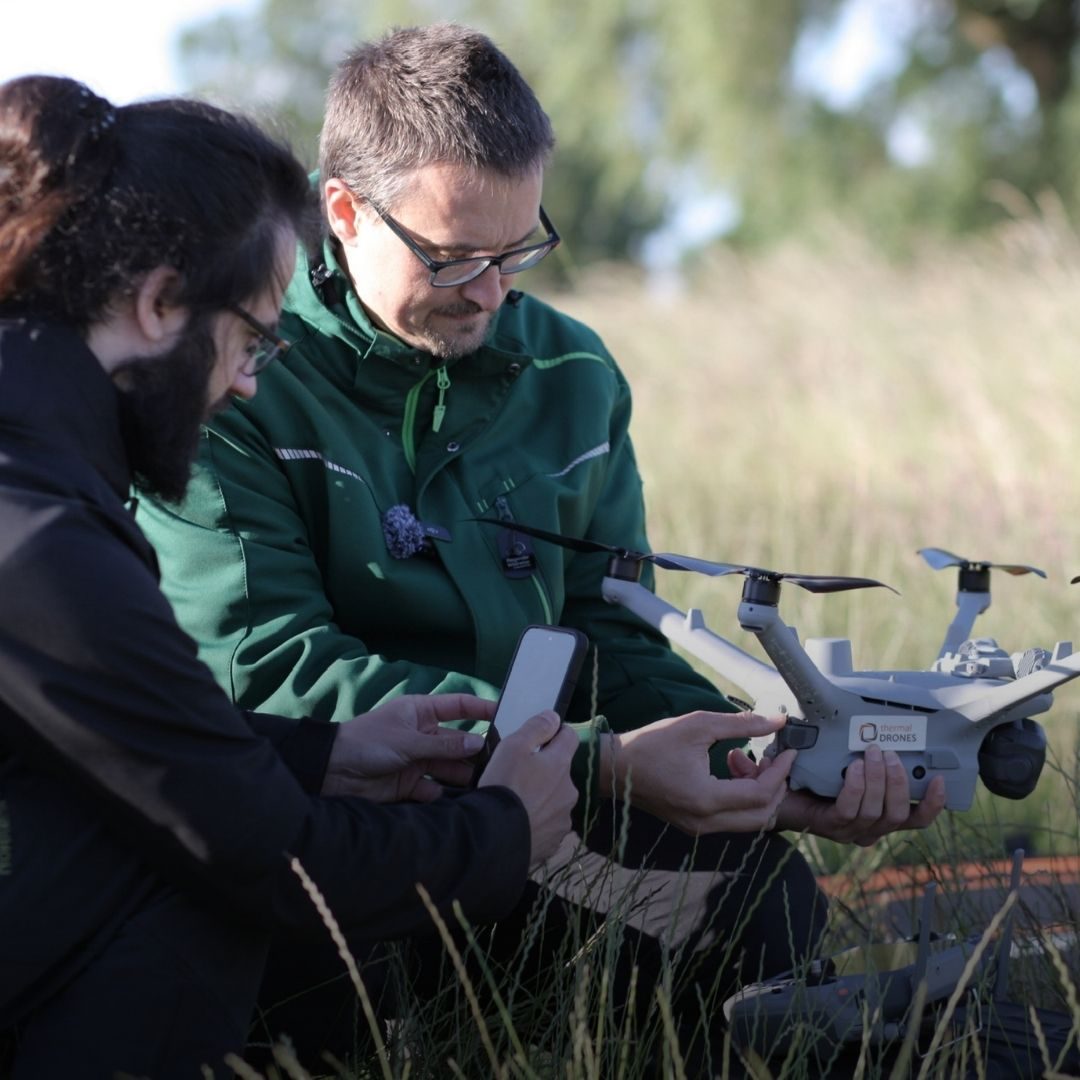
For your first flight, find an open area far away from people, trees, power lines, and buildings, on a calm day. The launch site should be level and firm so that the camera and propellers don't touch the ground.
Before launching, familiarize yourself with the drone and remote control, especially with the automatic safety features like Return to Launch. Then practice calmly.
Check before every start
- Drone software and databases are up to date
- Drone and remote control batteries fully charged and correctly inserted
- Propeller correctly mounted, secure and undamaged
- Sensors calibrated, especially the compass
Regulate
The most important rules for drone flight
- Maximum 120 m above ground
- Fly only within visual range
- Never over crowds
- Keep a safe distance from residential areas, roads, railway lines and industrial facilities; the exact distances are shown on the dipul map.
- Flying in nature reserves is only permitted with the approval of the responsible authority.
Frequently Asked Questions
Frequently asked questions about getting started with drones
Do I need to register my drone?
You must register as the operator as soon as your drone weighs 250g or more or carries a camera (toys excluded). This applies to all thermal imaging drones. The operator is registered, not the individual drone.
How much does it cost to register a drone?
A one-time fee of €20 applies to private individuals and €50 to legal entities such as associations (as of October 2026). The A1/A3 competency certificate costs €25, and the LBA charges €30 plus the testing center fee for the A2 remote pilot certificate.
How long does registration with the LBA take?
For private individuals, the process is often quick. Applications from clubs and companies are reviewed manually by the LBA (German Federal Aviation Office), which can take several weeks. You are not allowed to fly without a valid e-ID, so register well in advance of the season.
Do all club members have to register?
No. If the club is registered as the operator, its members fly under its e-ID. However, each pilot needs their own proof of competence, i.e., the A1/A3 competency certificate or the A2 remote pilot certificate.
What drone license do I need for fawn rescue?
Das hängt davon ab, wie nah ihr an Unbeteiligte heranfliegt. Für die Wildtierrettung gelten abweichende Abstandsregeln, die wir im Beitrag Drohnenrecht: Ausnahmen zum Wildtierschutz erklären. Im Zweifel beraten wir euch gern.
Is the operator ID the same as the remote pilot ID?
No. The operator ID (e-ID) is received by the operator upon registration; it is attached to the drone and the remote control. The remote pilot ID serves as proof of the pilot's identity.
Continue to the introduction
Training, Law and Practice
-
Drone training
Training on your drone, flight exercises and team procedures: on site, online or in a webinar.
Regarding the training courses -
Fawn rescue using a drone
How teams using thermal imaging drones and POISuite save fawns from mowing.
For fawn rescue
As of October 2026: Sources
Fees and procedures are as specified by the German Federal Aviation Office. The legal texts and information provided by the authorities are legally binding.
Advice