
For farmers and agricultural contractors
Fawn Rescue Before Mowing: Register Your Fields in POICloud
Mowing season puts farmers and agricultural contractors under heavy time pressure and stress. In fawn rescue before mowing, a team searches your meadow early in the morning with a thermal drone and secures the fawns. You report the field and mowing date in POICloud, the team searches, and you mow soon after.
For wildlife, for your livestock, for the drivers
Why You Should Have the Meadow Searched Before Mowing
Fawns spend their first weeks of life alone in tall grass. When danger threatens, they do not flee but press themselves flat to the ground. In front of a mower that is deadly. The same goes for young hares and the clutches of ground-nesting birds.
Fawning season runs from April into July. Hay mowing and the second cut from around mid-June are affected too, because late fawns turn up well into summer. You can never be completely sure that no animal is lying in the meadow.
When no wild animals are in the field at mowing time, that benefits not only the animals that are saved. It also helps keep feed quality high, takes some pressure off your machine operators during a demanding time and helps you take precautions before mowing.
Your part
Three steps for fawn rescue on your fields
Fawn rescue for farmers means: have the meadow searched first, then mow.
-
Step 1
Report your field
Use your team's sign-up link to add your field, without your own account and without a password. You receive your personal link by email.
-
Step 2
Request a mowing date
You submit the mowing date as a request, ideally one to two days ahead. If it shifts because of the weather, correct it in POICloud. You cannot currently withdraw an accepted job yourself; contact the team.
-
Step 3
Mow soon after the search
Secured fawns should be released quickly, and a doe may lay new fawns in the field. No more than two to three hours should pass between the search and the start of mowing. POICloud tells you when your fields have been searched completely.
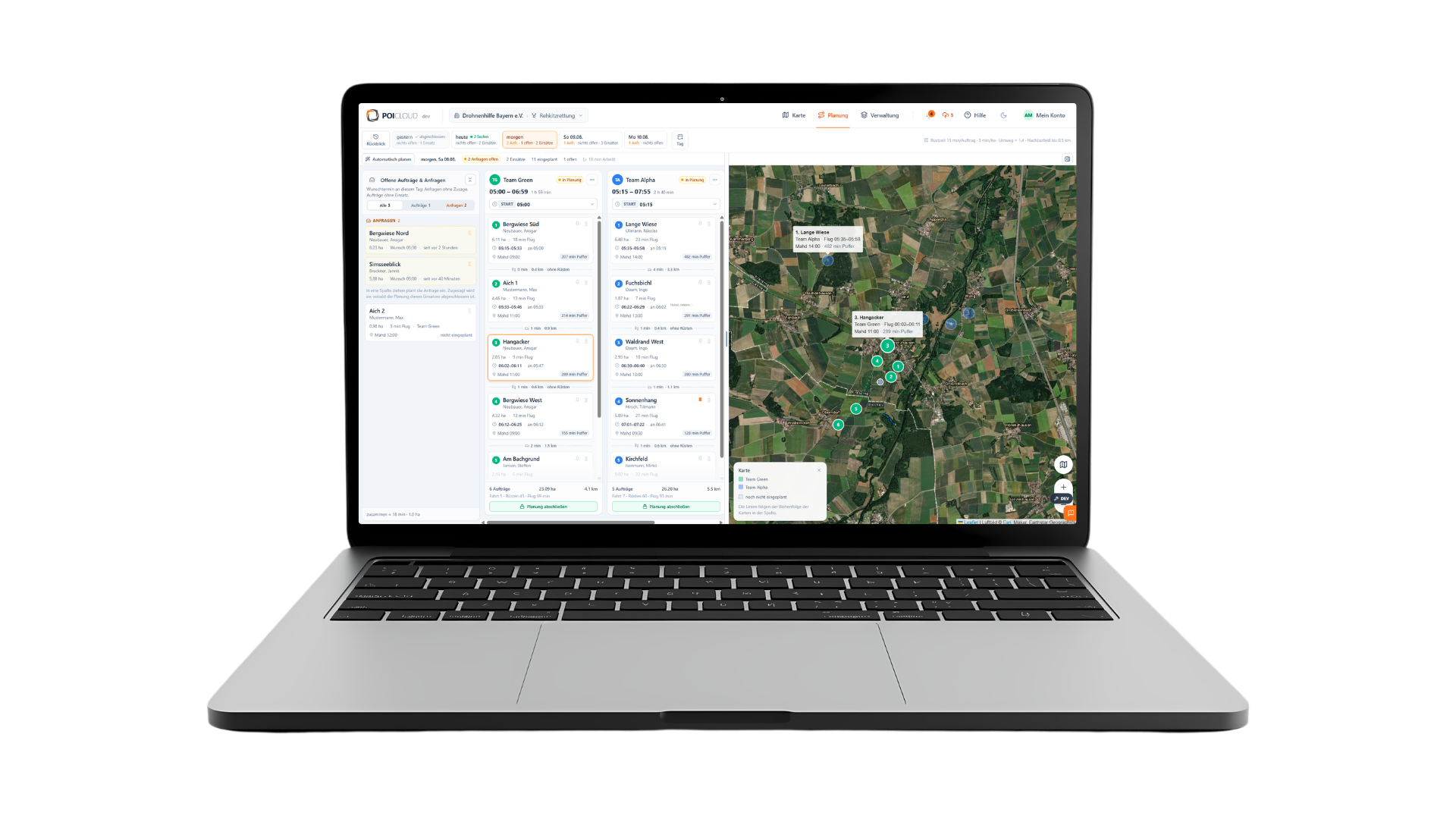
By the way: fawn rescue teams use POICloud free of charge
Fawn rescue teams can use POICloud free of charge and so save a lot of time, for you and for themselves. Tell your team about the options. We are happy to advise!
Registering fields
Registering Fields in POICloud: No Account, No Password
If your fawn rescue team works with POICloud, you register your fields there yourself. POICloud keeps fields, requests, the operation plan, finds and reports in one place. All you need is a current browser on a phone, tablet or PC. In the first year you create your fields once; from the next year on, all the data is already in place.
The diagram shows how farmers can register their fields for fawn rescue, from the link to the job. How an association runs a whole season this way is described in the case study Fawn Rescue Mangfalltal. How the team sets up its page and accepts jobs is covered in Organizing Fawn Rescue with POICloud.
Process
How registration works: from link to job
- Sign-up page you register once on your team's page
- or Invitation the team sends the link by email or WhatsApp
-
Contact link
your personal access, no account or password
Browser
-
POICloud
creates your field: by click, drawn or from file
Request
-
Farmer
submits the request with the mowing date
Email
-
Dispatch
accepts it and creates the job with team and date
Step 1
Register once and get your contact link
On the team's sign-up page you first enter your name and address and then add your fields. You then receive your personal link, the contact link, by email. Save it as a bookmark: with it you can come back at any time and see your fields, jobs, operations and reports.
If the team already knows you, it may also send you the link directly by email or WhatsApp. If you lose the link, ask the team for a new one.
Step 2
Three Ways to Add a Field
You do not have to draw your meadow by hand. Choose what is quickest for you.
-
Fastest
One click into the field
POICloud detects the field boundary in the aerial image and creates the field as a polygon.
-
More control
Draw it yourself
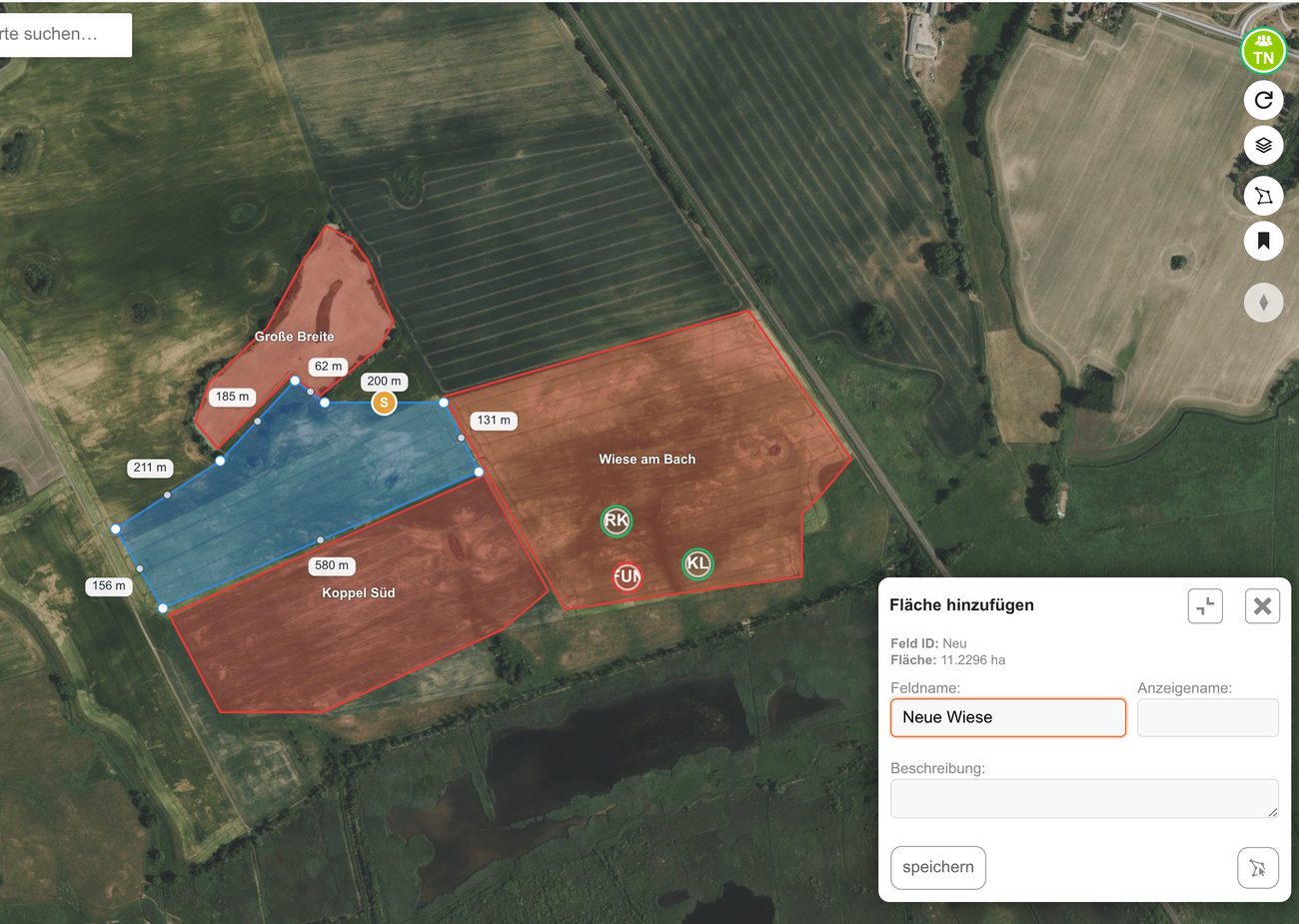
You draw the boundary on the map, also at the edge of the field on your phone. The length of every edge is shown, and POICloud calculates the area.
-
Many fields
Import from a file
Existing field boundaries, for example from your farm records, can be imported as KML, KMZ, GPX, JSON or CSV. You get a preview first, and POICloud detects duplicate fields.
Describe the field
Name the field, add notes
Give each field a name, for example "Meadow by the stream". That saves the team time when planning the operation.
Add what helps on the day: access route and take-off spot, new fences, power lines or groups of trees – that makes the day of the operation easier.
Step 3
Request a Mowing Date: Date, Time, Notes
You submit the mowing date for fawn rescue as a request: select the field on the map or in the field list, ideally one to two days before mowing. The form asks for what the team needs to know, such as the mowing date. The team decides which details these are.
The team receives an email and accepts the request. It becomes a job with a team and a date. If the mowing date shifts, update it in POICloud too. Also tell the hunting rights holder about the mowing: your request in POICloud does not replace that arrangement.
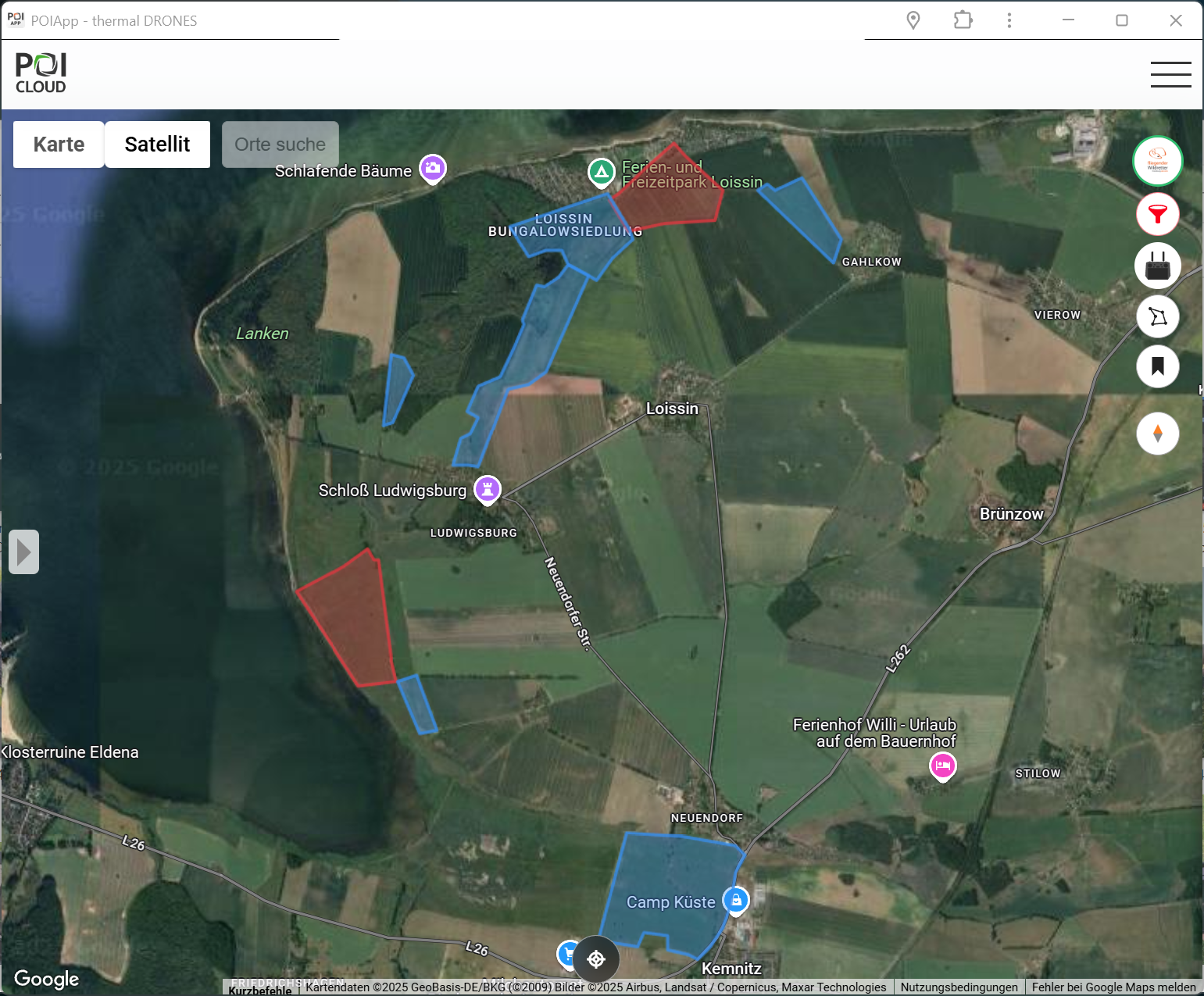
The colour of the field shows its status
| Colour | Meaning |
|---|---|
| Blue | No job |
| Red | Open job |
| Green | Done |
On the day
On the Day of the Operation You Follow Along
Through your link you find your fields, jobs, operations and reports. Depending on what the team enables, you also see the finds and, in the live stream, what the drone sees. That way you know when the search of your field is finished.
You do not see other farms' data, and no other farm sees yours.
Once the field has been searched, the team closes the job. Your field turns green, you see right away that the job is closed, and you mow soon after.
Access
What You Can Do with the Contact Link
| Task | You with contact link |
|---|---|
| Create and edit fields | yes |
| Submit requests and create jobs | yes |
| See the operation schedule | yes |
| Retrieve the job report | yes |
| See finds | with team approval |
| See the drone's live image | with team approval |
| Confirm finds | no |
| Plan operations and export data | no |
Proof
The Report: Proof, Not a Guarantee
After the operation you receive the job report as a PDF. It documents what was flown and found, and serves as proof for the farmer, the authorities or an insurer.
Important: the report does not guarantee that the field is free of animals. The shorter the gap between the search and mowing, the less likely it is that animals are still in the field. But even a search with modern thermal drones can never rule out that an animal is overlooked.
Background
Avoiding Mowing Deaths: What Is at Stake for You
Nobody wants to kill an animal when mowing. Wildlife rescue before mowing works best when farmers, agricultural contractors, hunters and volunteers cooperate and trust each other. Still, it helps to know the consequences of a mowing death.
-
Law
A criminal offence under section 17 of the Animal Welfare Act
In Germany, anyone who kills a vertebrate without good reason can be punished with up to three years in prison or a fine. This requires intent, but it is enough to accept the death as a possible consequence. The farmer and the person actually driving the machine are chiefly responsible; courts have also convicted contractors and their drivers. This is not legal advice.
The legal situation at a glance -
Feed
Botulism in silage
Carcass parts in silage can cause botulism in cattle and horses. Losing a heifer or cow outright quickly costs several thousand euros; lost silage and the vet each cost several hundred euros.
Economic consequences of a mowing death
Also helpful
What Else Helps
The drone is one building block. These measures complement it.
-
Mowing equipment
Cutter bars are gentler than rotary mowers. A cutting height of at least 12 cm spares brown hares, among others.
Mowing strategy in detail -
Mowing pattern
A mowing pattern with an escape route helps animals that can flee. Mowing from the centre outwards or from one side to the other should therefore be standard. It does not help fawns, ground-nesting birds and small hares in their first days, because they press themselves down and stay put.
-
Scarecrows and deterrents
Scarecrows are set up one to two days before mowing. Their effect is limited: in the WiOPro project at South Westphalia University of Applied Sciences, the success of deterrence ranged from 0 to at most 50 percent depending on the method (preliminary results, top agrar, 2025). Acoustic wildlife deterrents on the mower do not drive away fawns under three weeks old.
-
Ground-nesting birds
The team also finds clutches of ground-nesting birds such as lapwing or skylark. The coordinates go to you so you can leave the area out when mowing.
In your region
Fawn Rescue Near You: Find a Team
Many farmers report their mowing dates through their hunting tenant. They know the farmers in the hunting district and in many places coordinate fawn rescue, so ask locally first. Established wildlife rescue associations are good partners. If the team works with POICloud, it gives you the sign-up link for your fields.
-
Fawn rescue team
Commission a team
Teams that work with POICloud give you the sign-up link. If you do not know a team, ask us: on request we put you in touch with users of our system in your region.
Ask us for a contact -
Agricultural contractor
Agree it with your contractor
For agricultural contractors, fawn rescue means above all one thing: never start a cut on a field that has not been searched. If an agricultural contractor mows for you, settle with the farmer and the team beforehand whether the field has been searched for fawn rescue. The person actually driving the machine is also responsible.
The legal situation at a glance -
Your own drone
Build your own team
If you want to search yourself, as a farm, contractor or hunter, start with training and funding. With a DJI Enterprise thermal drone from our shop, POICloud is included permanently at no cost.
View training courses
Fawn search and hunting law
Catching and holding fawns to save them from mowing is often associated with poaching. In our view the legal situation is considerably more complex, but the first step should always be to inform the hunting rights holder and ask them for help.
More in the article Can wildlife rescue be considered poaching?
This is not legal advice.
Frequently asked questions
Frequently Asked Questions from Farmers and Contractors
Do we need a POICloud account?
No. Through the team's sign-up link you report field and mowing date without your own account and without a password. You receive your personal link by email. You do not have to install anything, a current browser is enough. Whether the team charges for the search, and how much, is something to settle with the team.
What can we see through our link?
Your own fields, jobs, operations and reports. Depending on what the team enables, also the finds and the drone's live stream. You do not see other farms' data.
How early should we report the mowing date?
Ideally one to two days ahead. The day before, check the date and correct it if necessary, because mowing dates shift with the weather.
My fawn rescue team does not use POICloud. What can I do?
Pass on the tip: every team creates its own sign-up link in POICloud, and an account is free. We show teams how to get started in a demo.
Is the field certainly free of animals after the search?
There is no guarantee. The thermal image shows what is warm, and in very dense vegetation an animal can stay invisible. The report documents what was flown and found. So mow soon after the search.
What happens to the fawns that are found?
Helpers secure them in a protected place and log them in the POIApp. After mowing the animals are released as soon as possible near where they were found, so they can rejoin the doe. A marker with a QR code leads back to the place where they were kept. How to handle fawns correctly is explained in Can you touch fawns without gloves?
We have already mowed. Can we withdraw the request?
You cannot currently withdraw an accepted job yourself. Contact the team; the dispatcher deletes the job. Important: fields should always be searched before mowing. Breaking arrangements with the volunteers leads to frustration, and the farmer loses valuable helpers for the mowing season.
What applies to agricultural contractors?
The person actually driving the machine is also responsible; courts have convicted contractors and their drivers. So agree with the farmer and the team before mowing whether the field has been searched. This is not legal advice.
Is there funding for my own drone?
In recent years the federal government, the BG BAU and individual federal states have offered funding. Conditions change from year to year, applications usually have to be made before purchase, and not every programme is open to farmers. We will tell you what currently applies in a consultation.
Advice