Matrice 4TD or 5TD for Missing Person Searches? The Sensors Decide
Which thermal imaging drone suits missing person searches: thermal camera, zoom, laser and night vision compared, and only then the question of the dock.
Matrice 4TD or 5TD for Missing Person Searches? The Sensors Decide
In a missing person search every minute and every pixel counts. Which thermal imaging drone suits your drone team depends first on the sensors: thermal camera, zoom, laser and night vision. Whether you need a dock is the second question.
This article compares the DJI Matrice 4TD (and the DJI Matrice 4T) with the DJI Matrice 5TD by what their sensors do when you search for missing persons.
Short answer
Which sensors matter in a missing person search?
Do you search smaller areas and get to the scene quickly with the drone? Then the Matrice 4T or 4TD is enough in many cases: portable, thermal camera with 640 × 512 pixels, zoom and laser on board.
Do you search large areas, at night or in winter? Then the Matrice 5TD offers more: twice as many thermal pixels in each direction, stronger zoom, laser up to 3 km, a more light-sensitive camera, more flight time and a temperature range down to −40 °C.
You decide on the dock afterwards, see below.
Requirements
What a missing person search needs from a drone
- Detect a person in the thermal image, even when they are only a few pixels in size.
- Clarify a heat spot: person, wild animal or warm surface, without flying lower.
- Report the exact location of the find to the incident command.
- Fly at night and in poor light.
- Search a lot of area in a short time, with few pauses.
- Work reliably in cold and wet conditions.
- Be connected to your incident command and your teams in the field via POICloud.
Thermal camera
Thermal resolution: spotting a person even from great height
The 5TD has a thermal camera with 1280 × 1024 pixels, the 4T and 4TD one with 640 × 512. According to dealer information the field of view is the same, 45° diagonal. You see the same area on the ground, but with twice as many pixels in each direction.
The calculation below is our own, derived from the manufacturer's data, not a DJI figure. It applies to a thermal image looking straight down and a person lying down, about 1.70 m long.
Calculation example: thermal image looking straight down
| Flight height above ground | 50 m | 80 m | 120 m |
|---|---|---|---|
| Image width on the ground (both) | about 32 m | about 52 m | about 78 m |
| Pixel size Matrice 4T / 4TD | about 5 cm | about 8 cm | about 12 cm |
| Pixel size Matrice 5TD | about 2.5 cm | about 4 cm | about 6 cm |
| Person (1.70 m), 4T / 4TD | about 34 pixels | about 21 pixels | about 14 pixels |
| Person (1.70 m), 5TD | about 68 pixels | about 43 pixels | about 28 pixels |
The difference shows in the strip width. From 120 m the 5TD has the same pixel size as the 4TD from 60 m, about 6 cm. The strip is roughly twice as wide. With the same level of detail you therefore need about half as many flight lines for the same area. 120 m is the usual upper limit, which you as the operator have to check for your own operation. For sensitivity the manufacturer states the same values for both, so we cannot prove an advantage for the 5TD there.
How well a thermal image searches also depends on the surroundings. Contrast is greatest when the surroundings are cooler than the person, at night or early in the morning. On sun-heated ground it is low. Under dense foliage every thermal camera sees little.
Pros and cons of high resolution
High thermal resolution is not all upside
The 5TD shines with four times the number of thermal pixels. The big advantage is that you can make out more detail. There are drawbacks too. Too much detail and too many pixels can overwhelm you when you analyse the thermal image, and the high resolution comes from microbolometer pixels half the size (8 instead of 12 µm), which could affect sensitivity. The greater distance between target and camera also means the atmosphere affects the image more. Overall, though, the advantages clearly outweigh the drawbacks.
Zoom
Zoom: clarifying a heat spot without flying lower
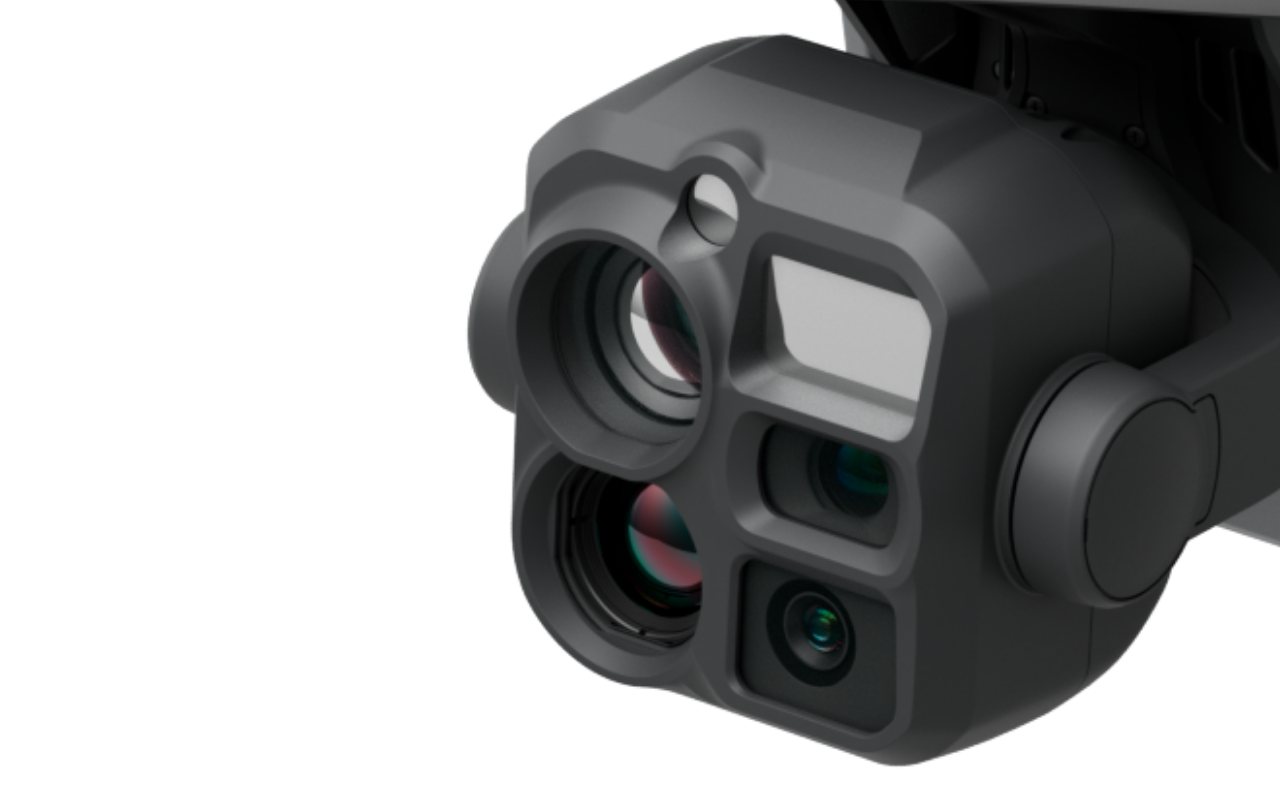
Both drones carry three cameras. The 5TD has 3 × 50 MP with 1×, 3× and 11× and up to 176× hybrid zoom. The 4T and 4TD have 3 × 48 MP with 1×, 3× and 7× and up to 112× hybrid zoom.
What this means for you: if you spot a point in the thermal image, you use the zoom camera to clarify whether it is a person, an animal or a warm surface. The drone stays at height and you do not have to abort a sector. With the same image section you stay about 1.6 times as far away at 11× as at 7×. That is our own calculation from the zoom levels.
Laser
Laser rangefinder: reporting the find to the incident command
The laser reaches up to 3 km on the 5TD and up to 1.8 km on the 4T and 4TD. It measures the distance to the point the camera is aimed at. From that, the position of the target follows.
What this means for you: you pass the coordinates of the person you found to the incident command and rescue teams without circling over them. In rough terrain, on a slope or on water that is valuable, because the way there can be longer than the straight line.
Night vision
Low-light conditions: the night search
The 5TD has an RYYB sensor that, according to the manufacturer, captures up to 40 % more light. The 4TD has a night scene mode with NIR auxiliary light.
What this means for you: missing persons are often searched for at night. The thermal image finds the person, and the colour image helps you orient yourself in the terrain and assess the find. The more light-sensitive the camera, the more you see there.
AI and safety
AI detection, radar and Remote ID detection
According to the manufacturer the 4TD detects people, vehicles and ships, the 5TD 17 target types. The detection helps when searching, but it does not replace the eye of the person who evaluates the thermal image.
On the 5TD, radar for obstacle detection and Remote ID detection are built in. On the 4TD, radar is only an optional accessory and costs flight time, and there is no Remote ID detection. What this means for you: on night flights over terrain with trees and power lines, obstacle detection helps. Remote ID detection shows nearby drones that transmit their ID, for example those of onlookers at the scene.
Flight time and weather
Flight time, range, payload and cold
The 5TD flies up to 59 minutes and 53 km, the 4TD up to 54 minutes and 43 km. The additional payload is up to 450 g on the 5TD and up to 240 g on the 4TD. Which accessories you can carry with that, clarify before you buy.
Both are rated IP55. The 5TD works down to −40 °C, the 4TD down to −20 °C. That counts in winter searches, when cold also becomes dangerous for the missing person.
Overview
Sensors compared and what they do in a missing person search
| Sensor | Matrice 4T / 4TD | Matrice 5TD | Benefit in a missing person search |
|---|---|---|---|
| Thermal camera | 640 × 512 | 1280 × 1024 | Spot a person even from great height, wider strips |
| Zoom | 3 cameras, 1× / 3× / 7×, up to 112× hybrid | 3 cameras, 1× / 3× / 11×, up to 176× hybrid | Clarify a heat spot without flying lower |
| Laser | up to 1.8 km | up to 3 km | Report the find to the incident command |
| Night vision | Night scene mode with NIR auxiliary light | RYYB sensor, up to 40 % more light | Orientation and assessment at night |
| AI detection | People, vehicles, ships | 17 target types | Help when searching |
| Radar and Remote ID detection (4TD) | Radar optional, no Remote ID detection | Radar and Remote ID detection built in | Safer night flight, spotting drones at the scene |
| Flight time (4TD) | up to 54 min | up to 59 min | Fewer pauses during the search |
| Temperature | −20 to 50 °C | −40 to 50 °C | Search in winter |
Decision aid
If you …, then …
Do you need a drone that a pilot takes along to the scene, for small and medium areas? Then take the Matrice 4T or 4TD.
Do you search large areas, regularly at night or in winter? Then the Matrice 5TD has the better sensors: more pixels, wider strips, a more light-sensitive camera, radar and the larger temperature range.
Do you need interchangeable sensors or even more payload? Then take a look at the DJI Matrice 400 RTK and Matrice 350 RTK.
Second question
With or without a dock?
The 4TD flies from the DJI Dock 3 or by hand, the 4T always by hand. The 5TD is the drone of the DJI Dock 4 and is not regularly intended for controller operation.
For missing person searches a dock pays off if you want to keep the drone ready at the station. It then takes off without anyone having to drive to the scene first, and you control it from the browser via DJI FlightHub 2. On the 5TD the battery change in the dock takes under 25 seconds, so the search continues almost without a pause. In return the dock has to be set up and approved, and missions beyond visual line of sight depend on the operator and the competent authority.
FAQ
Frequently asked questions about Matrice 4TD and 5TD in missing person searches
Does a thermal camera find missing persons in a forest?
Under dense foliage every thermal camera sees little, because the heat radiation barely reaches the sensor. Clearings, paths, forest edges and the leafless season are better. So never promise that a forest has been searched.
Is the thermal image of the Matrice 4TD enough for searching for people?
For many missions yes, especially from low altitude and over small areas. The 5TD offers more reserve at great height and over large areas.
Can I fly the Matrice 5TD without a dock?
It is not regularly intended for controller operation. A restricted emergency mode with the DJI RC Plus 2 has been announced.
Is the Matrice 5TD approved for fire services and rescue services?
We make no blanket statement on that. Approvals for missions beyond visual line of sight depend on the operator and the competent authority. We are happy to clarify what applies to you in a consultation.
How much does the Matrice 5TD cost?
DJI does not state a public price; sales go through enterprise dealers. Ask us for a quote.
Consulting